
How to Search Criminal Dockets
Coffee County offers two official entry points, each answering a different question. When you want to know what a judge will hear on a given day, open the Coffee County Court Dockets index, which posts date-specific PDFs sorted by court, judge, and calendar type. When you want to match a party name or case number to a record, use the Coffee TNCRTInfo case search for Circuit or General Sessions files. Neither tool is a certified copy of every paper filed.
Before you type anything, gather three things. Get the party name, the likely filing year, and the court level. An exact Coffee County criminal case number works best. A partial name can still get you there.
- Choose the dated docket index for a hearing list or TNCRTInfo for case metadata.
- In TNCRTInfo, leave Criminal selected and choose General Sessions, Circuit Court, or both.
- Enter a party name or case reference. For a full number, use the numeric part after the last hyphen.
- Complete the Turnstile check, run the search, and note the exact court and case number.
- Call or visit the Circuit Court Clerk when the setting, disposition, or certified record is unclear.
Need help with the portal controls? The Coffee County case search instructions walk through them step by step. One caution matters here. A row missing from the results does not mean the charge was dismissed. The case may simply be too new, restricted, municipal, federal, or filed in the other trial court. Check before assuming anything.
Coffee County Criminal Court Days
General Sessions Criminal in Coffee County runs on a steady weekly rhythm. Criminal court convenes Monday, Tuesday, and Thursday, per the county. Judge Greg Perry presides over Part I. That part sits on Tuesday. Judge Gerald Ewell Jr. handles Part II on Monday and Thursday. Trials and preliminary hearings fill the afternoon docket. Treat these as routing facts only. The dated Coffee County criminal court docket governs every setting. The official General Sessions Criminal page lays out that court's scope and schedule.
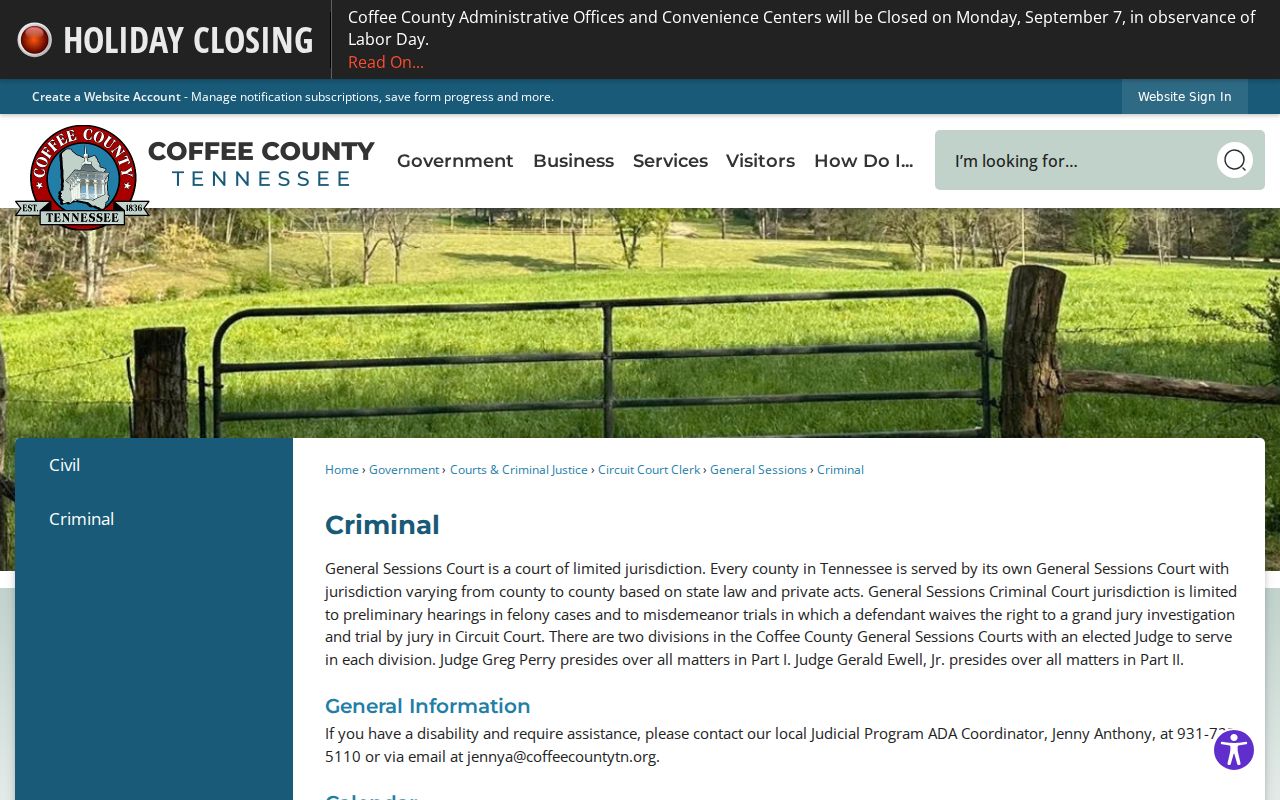
This view ties the recurring court days to the county office that posts the criminal docket details. Always weigh the pattern against the newest PDF or a confirmation from the clerk. Why does one case hop between courts? General Sessions tries misdemeanors when the defendant waives the grand jury and the Circuit jury trial. It also holds preliminary felony hearings. A case can therefore open in General Sessions. It may show later Circuit activity under a different reference number.
What a Criminal Docket Shows
Think of a published Coffee County criminal docket as a snapshot of the schedule, nothing more. General Sessions samples list the date, time, page, judge, court, and case block. Some blocks add charge and bond data. Circuit samples follow a similar format. Yet a PDF is not a full filing history, financial ledger, linked appeal, or complete set of orders.
| Case number | Observed forms include 16GS1-2026-CR-576 and 16CC1-2025-CR-49970. They are format examples only. |
|---|---|
| Case style | The State of Tennessee and party are identified, with attorney or prosecutor labels when shown. |
| Charge fields | A count, Tennessee statute, offense description, and agency may appear. A charge is not a conviction. |
| Bond fields | Samples may show type, amount, and bonding entity. Those fields describe release terms, not guilt. |
| Hearing type | Status, preliminary, or arraignment labels show planned work. They do not prove what occurred. |
The docket entry itself only names what happened on a given date. For the plea, dismissal, judgment, sentence, or any certified outcome, ask the Circuit Court Clerk for the named document or inspect the file if access is allowed.
Coffee County Criminal Docket Labels
Coffee County splits its General Sessions criminal docket PDFs into four families: Preliminary, Additional, Special Set, and Add-On. Circuit Court lists run under different names. Examples include Judge Lockhart Preliminary, Final Arraignment, Criminal Docket, and Judge Carter Preliminary. Knowing these labels helps. A caller can name the exact docket list being checked when contacting the clerk.
- Preliminary
- A local calendar category that can include a preliminary hearing, not a conviction finding.
- Special Set
- Work placed on a specially designated docket. The label does not state the result.
- Add-On
- A case added to scheduled court work. It does not mean a new charge.
- Status
- A scheduling label seen in a sample header, not a final disposition.
- Final Arraignment
- A named Circuit calendar type, not the final case outcome.
Coffee County publishes no official disposition-code dictionary. When a label on the criminal docket is unclear, quote it as written and ask the clerk.
Stages on a Criminal Docket
A Coffee County case can pass through several settings, and not every case uses each step. General Sessions may hold an initial or preliminary stage. A felony matter can move up to Circuit Court, while some misdemeanors conclude in General Sessions. Motions and resets can add dates between those points.
Docket flow: Filing › Arraignment › Pretrial › Plea or Trial › Disposition › Sentencing
Read the criminal docket as a snapshot, not a verdict. An arraignment entry only names a hearing type the court has scheduled. A status line is not a plea. Likewise, the charge and its statute set out an allegation, nothing more. Want to know how the case actually ended? Look for a later entry or a filed order rather than the first schedule where it appeared.
When a preliminary matter moves forward, keep the General Sessions number handy. Then check whether Circuit gave the case a new one. Search both court dockets. That way, linked phases of one prosecution do not look like two unrelated cases.
Coffee County Criminal Case Codes
A Coffee County case number holds routing clues. General Sessions samples show the tag 16GS1, while Circuit samples carry 16CC1. Next comes the year. The letters CR flag the criminal segment. Treat this as a guide, since older files can break the pattern.
TNCRTInfo throws one quirk at you. Its help text says to type only the numeric part after the last hyphen. For 16GS1-2026-CR-576, that means the final number goes in the case-number box and the year gets its own field. Leave Criminal checked. Then pick the court that fits.
No result? Try the other court type, confirm the year, use a partial name, and consider whether the matter is municipal, juvenile, sealed, expunged, or federal.
The portal runs a Turnstile check before Find Now will respond. When a match comes up, write down the full case number and the court name so the clerk can pull the docket fast.
Which Court Holds Criminal Dockets
Coffee County Circuit Court holds the general-jurisdiction criminal docket. Judge William A. Lockhart presides over Part I. Judge Robert T. Carter takes Part II. General Sessions Criminal sits below it with limited jurisdiction, handling the preliminary-hearing and misdemeanor work described above.
| Court | Criminal role | Official route |
|---|---|---|
| General Sessions | Preliminary felony hearings and eligible misdemeanor trials | County PDFs, TNCRTInfo, Circuit Court Clerk |
| Circuit Court | General criminal jurisdiction and lower-court appeals | Judge PDFs, TNCRTInfo, Circuit Court Clerk |
| Municipal Court | Manchester or Tullahoma city citations | The issuing city's clerk |
| Appellate courts | Criminal appeals after trial-court action | Tennessee Public Case History |
In Coffee County, criminal dockets live with the Circuit Court Clerk, whose office keeps the court records for Circuit, General Sessions, and Juvenile cases. Chancery's Clerk and Master handles other matters, so steer criminal questions elsewhere, and any federal case belongs to the federal clerk through PACER.
Coffee County PDF Limits
A Coffee County PDF docket can tell you a lot at a glance. Who is on the schedule? Which judge presides? What kind of hearing is set? All of that appears in these files. Many also list charges, statutes, the arresting agency, and bond details. Still, treat the PDF as one window on the case, not the whole register. A disposition date may be missing. So can continuance history, restitution or a balance owed, a linked appeal, or filed attachments.
When the PDF shows no outcome, turn to TNCRTInfo. You can also call the Circuit Court Clerk at 931-723-5110. The office sits in the Justice Center at 300 Hillsboro Boulevard in Manchester. Hours are weekdays from 8:00 a.m. to 4:30 p.m. Mail a request to P.O. Box 629, Manchester, TN 37349, or fax it to 931-723-5116. Name the order, judgment, or date range you want. That helps the clerk pull it fast.
Never assume an old date simply rolled forward. Coffee County says its Circuit dockets have not been automatically continued since July 1, 2022. Check a current PDF or contact the clerk directly before you count on any listed date. One last note on timing: online docket files usually stay up during an office closure. So confirm counter hours before a same-day visit.
Public Access and Sealed Criminal Dockets
Tennessee leans toward openness, but public access stops at certain lines. Coffee County's own FAQ puts it plainly. A court file is public unless a judge orders it sealed, and juvenile files are confidential by law. Sealed records, protective orders, statutory exceptions, judicial working material, and completed expungements can each shrink what the public may see in a criminal docket.
For the governing framework, read the official Tennessee Supreme Court Rule 34 page. It lays out the rules that decide when a court record stays open and when it closes.
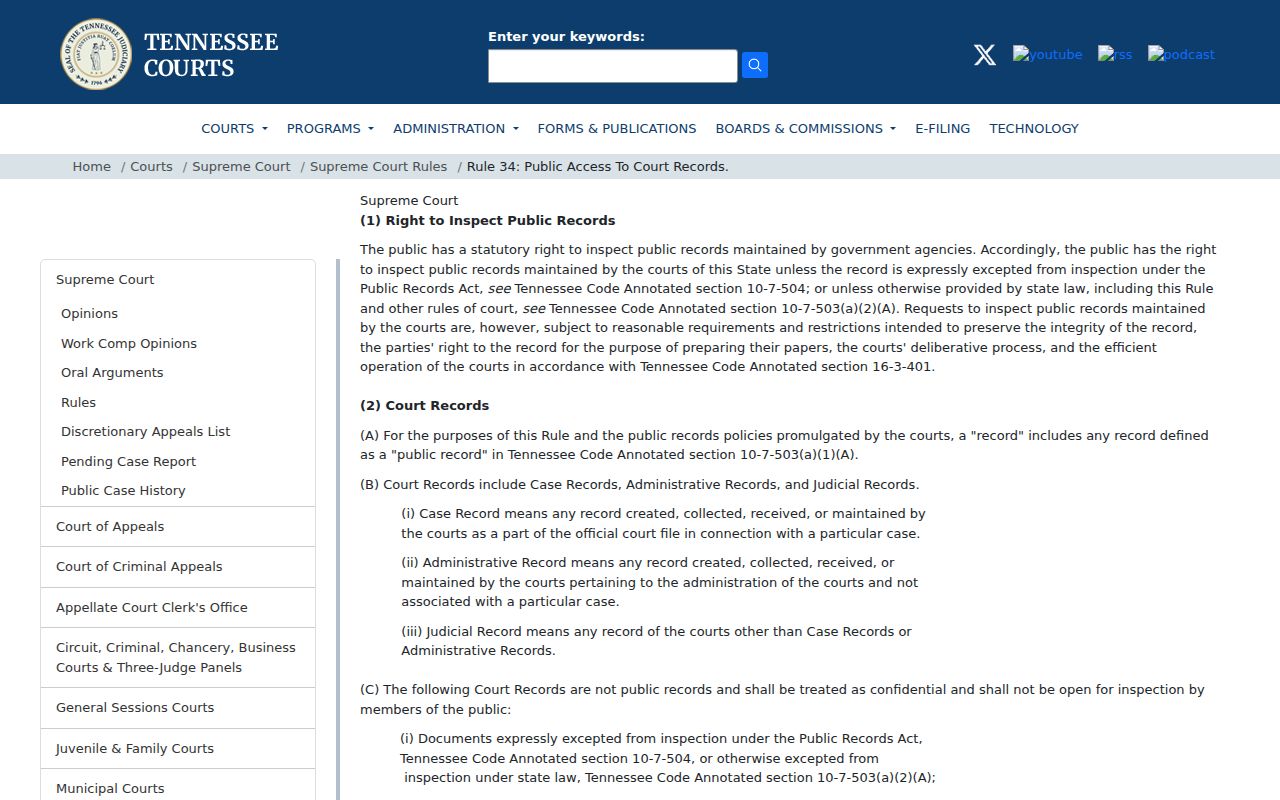
The rule explains the catch. A public docket result must be read against legal restrictions and the clerk's call on that particular file.
Key access rules:
Tennessee Supreme Court Rule 34 preserves statutory, sealed, protected, and judicial-function exceptions.
Coffee County court-record FAQ identifies sealed and juvenile limits.
Tennessee Courts expungement guidance directs requests to the originating court.
If you get only partial access, hold on to the case number. Ask the clerk which form of inspection or copy is lawful for that file. A public-record request cannot conjure up a record that does not exist, and it cannot override a sealing order or other restriction.
Coffee County Clerk Access Channels
Online tools are just one route to Coffee County court records. The Circuit Court Clerk also answers questions in person. Phone, mail, and fax work too, for both Circuit and General Sessions files. Say what you need: inspection, a plain copy, or a certified copy. Give the court, the case number, the record type, and a date range. No official source confirms a self-service public terminal. So call ahead rather than counting on one.
The county request form lets you choose inspection or a copy. Delivery options include pickup, first-class mail, electronic means, or another route. For a court file, name the Circuit Court Clerk as the likely holder. The countywide coordinator does not keep these dockets.
Manchester and Tullahoma clerks handle their own city citations. Tennessee Public Case History covers appeals, while PACER handles federal matters. Juvenile records follow confidential-record rules. These distinctions matter. TNCRTInfo offers only Circuit and General Sessions options for a docket search.